The book was recently released. I finished drafting and translating it into English at the end of September 2025. I had hoped to publish it for my trip to the United States in November, but the layout, artwork, copyright registrations, and printing took much longer.
Yet the book is simple. In every way.
I wanted to keep it simple, immediate, easy to read.
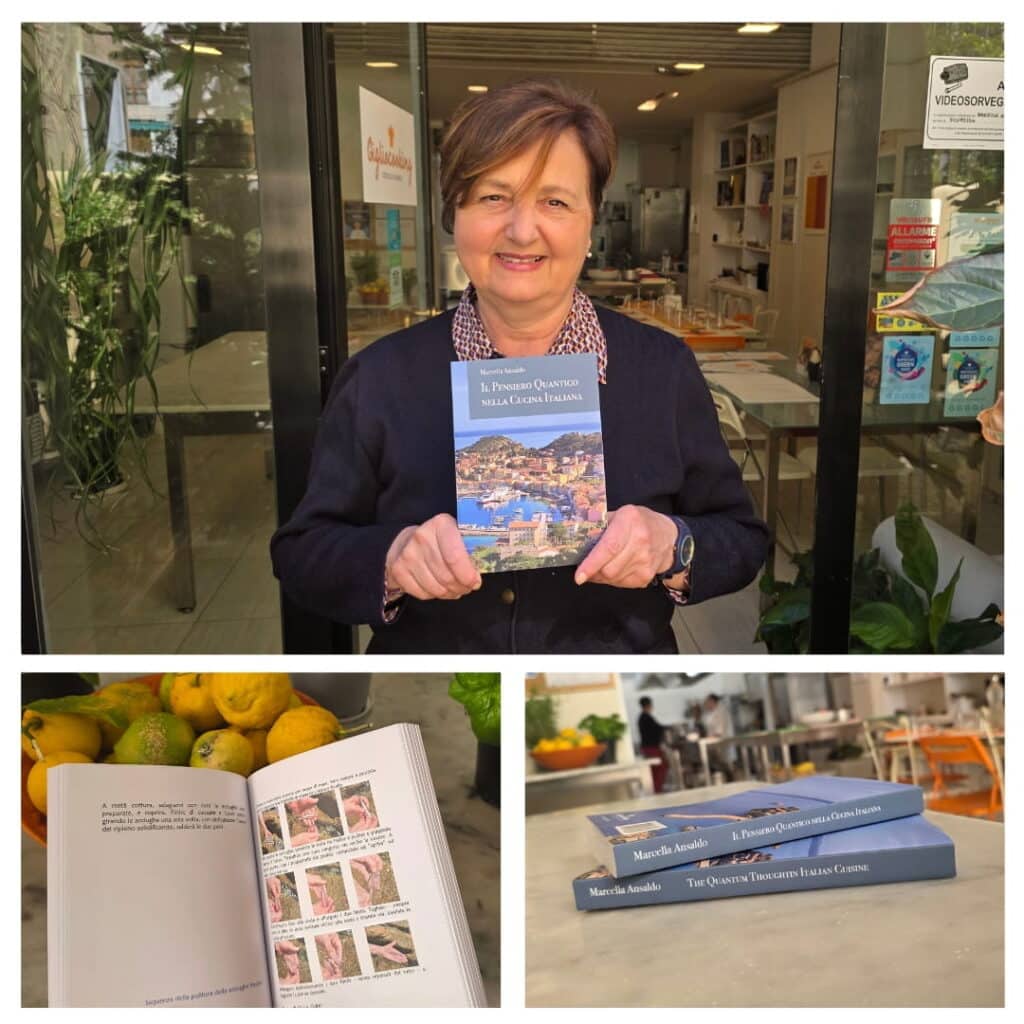
The graphic design responds to this need: there’s almost no graphic design—it was deliberately kept simple by graphic designer Valentina Ruocco Fiume—just as there are no psychological, cultural, or scientific overtones in the writing. It flows seamlessly, from hand to paper. The photographs were mostly taken by amateur photographers: I thank everyone for their collaboration. Their work further focuses the book’s meaning.
My sincere thanks to: Marta Mariuz, Silvia Zaini, Sergio Giorgi, Maurizio Pini, Joan Manalang for the photos.
My sincere thanks to Cinzia Oliviero, Renza Rum, Paolo Ansaldo, Franca Ansaldo, Luciana Calamai for their memories.
This book is a compendium of the physical and mathematical explanation of the book that preceded it: it talks about our connection to food as we manipulate it.
A book that talks about quantum physics must also be fresh.
More often, in our days, we should be free from fears and mental constraints and be able to grasp the intuition that passes before us, brushes our noses and too often flies away.
But intuitions are different from dreams. Intuitions come from an abstract place, which pierces us deep within, pervades our consciousness for a moment, and evaporates amid the tangle of information received in life: family, school, work.
We are full of information and let insights disappear.
Our mental superstructure often—we prefer reasoned thought to the flash of a crazy idea—prevents us from considering them important to the daily flow of our lives. But if scientists hadn’t stopped intuitions and focused on them, humanity would never have known progress. Perhaps this is precisely what being a genius means: distancing oneself from physical reality and wandering through the world of ideas until one captures and develops one that will become a discovery.
Do you think quantum physics has nothing to do with cooking? Quantum physics deals with everything. Everything follows the same rules: the universe, like the atom.
You have to LOOK. Just look. To look is to be pervaded by what is.
In English, “guardare” translates as “I Look.” The verb “sembrare” in English also intrinsically means “to be seen” and translates the same way: “il fiore sembra” (appears, is seen): the flowers looks. As if the subject who looks and the object being looked at were connected by a line. And indeed they are: as if looking and being looked at were the same thing.
We should be able to look without speculation or judgment (which I don’t yet know how to do), without justifications or interpretative complications. “That’s how it is if you like it,” wrote Pirandello. “It is as it is,” my mother used to say. “Look and learn,” goes a proverb.
Are we capable of looking, simply of looking? Here: simplicity seems to have become the most difficult thing. Perhaps if we stripped ourselves of what we think we know, we would be able to see reality. Look at a peach. What’s a peach like? Ripe, soft, with a hairy, watery, stringy, yellow…. Look at buckwheat flour. What’s buckwheat flour like? White and black, like sand… Look at things carefully. Look carefully at the foods: they will tell you what to do with them.
Marcella Ansaldo © 2026
Photos by Marta Mariuz © 2026
E-book in English available on Amazon:
amazon.it/dp/B0GLYRC4GD