
The monthly course began again last monday, with a group of students who could easily be teachers themselves. I’m looking forward to a month of absolute fun: when you have people who are already skilled in the kitchen and eager to give expression to their creativity, this course truly shines.
Yes, exactly! That is precisely what Italian Cuisine Through Time and Space was designed for: to introduce as many ingredients—within the constraints of the season and the limited timeframe (20 days is not very long)—and culinary techniques as possible. It aims to provide ideas and suggestions on how to approach a recipe when specific ingredients are unavailable, to foster an exchange of ideas among participants, and to encourage the mind to explore creative solutions. All of this is done without compromising the integrity of a dish, ensuring it remains succulent, flavorful, and well-balanced. We focus on the “numbers”—that is, the proportions—and teach fundamental techniques that are applied with increasing complexity as the course progresses and the recipes become more sophisticated. The goal is to ensure that when students return home—whether to Sri Lanka, Mexico, the United States, Canada, Norway, Brazil, the Netherlands, South Africa, or New Zealand (Gigliocooking students come from all over the world)—they are able to recreate dishes in the “Italian style”: a style that is simple and essential, yet not always easy to execute.
Who the students are:
Matthew—known as Max to his friends—comes from California. He made some major decisions this year: for starters, taking a sabbatical and… moving to Italy. He cooks for family and friends and is very knowledgeable about food.
Magdalena, who is of Polish origin and a naturalized American, hails from Seattle, Washington State; she is incredibly fast and precise with a knife. She has just sold her crêperie after 17 years in business. In the summer, she works as a chef on sailboats—her most recent adventure took her to the Galápagos.
Then there’s Martina, who—as she describes herself—is 50% American and 50% Italian, with parents of two different nationalities. Martina comes from the Chianti region; she is well-versed in meat and wine. She is also taking a sommelier course. She calls herself an American who has never lived in America. The expression “Ghost of the Tortellino” is hers. It really looks just like a tortellino without any filling!
Shirley: an Irish lady who knows Italy better than me. More than acting like teacher and students we seem old friends. She comes to Italy ofter and for long stays. After the beginning decision to take oly the very first lesson of the course, she decided to take the whole week instead. She will take the three remaining weeks next year.
The days spent together have been enjoyable: conversations, exchange, great cooperation around the kitchen: sensation of being connected.
Sue Campbell told me as much, many years ago: – only special people ever find their way to your school. – She said this back when the school had only just opened and didn’t have any clients yet. How did she manage to guess?
One of the recipes we made was fresh pasta, which we shaped and folded into a few different forms, including the Orecchiette Emiliane—that is the “Ghost of the Tortellino.”
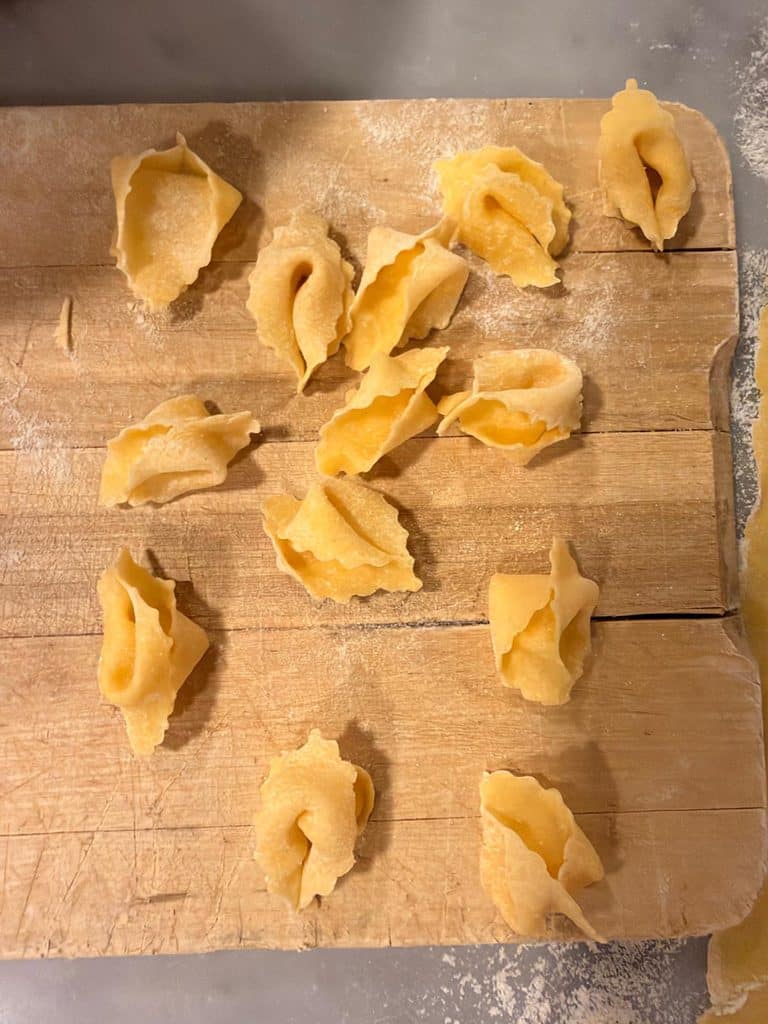
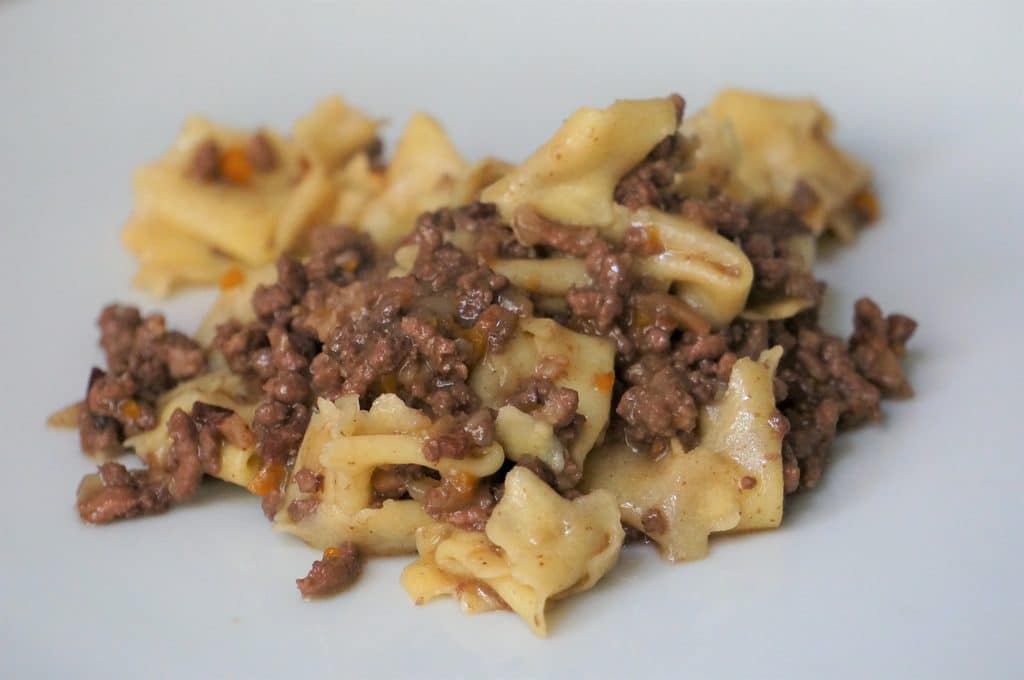
We dressed it with a succulent Bolognese sauce, which filled every single nook and cranny!
Here is the recipe:
RAGU’ BOLOGNESE
Ingredients for 4:
100 gr ( 3 Oz) ground pork meat
100 gr ( 3 Oz) ground veal meat
50 gr ( 1 ½ Oz) minced cured Pancetta
50 gr ( 1 ½ Oz) butter
1 medium onion
1 carrot
1 celery stalk
250 ml ( 1 cup) beef broth
120 ml ( ½ cup) red wine
salt and pepper
Peel, wash and mince the vegetables.
Melt the butter in a saucepan with the minced Pancetta; add the meats and braise for 10 minutes on medium heat.
Pour in the red wine, stir, let it to evaporate half.
Add the minced vegetables, lower the heat. Cook for 2 hours, stirring occasionally and adding the broth.
Regulate salt and pepper. Cook to reduce: the sauce must be thick and well amalgamated.
Note: optionally add a tbs of milk at the end.